🚨 The Legal Fine Print: 3 Contract Clauses Founders Should Never Ignore
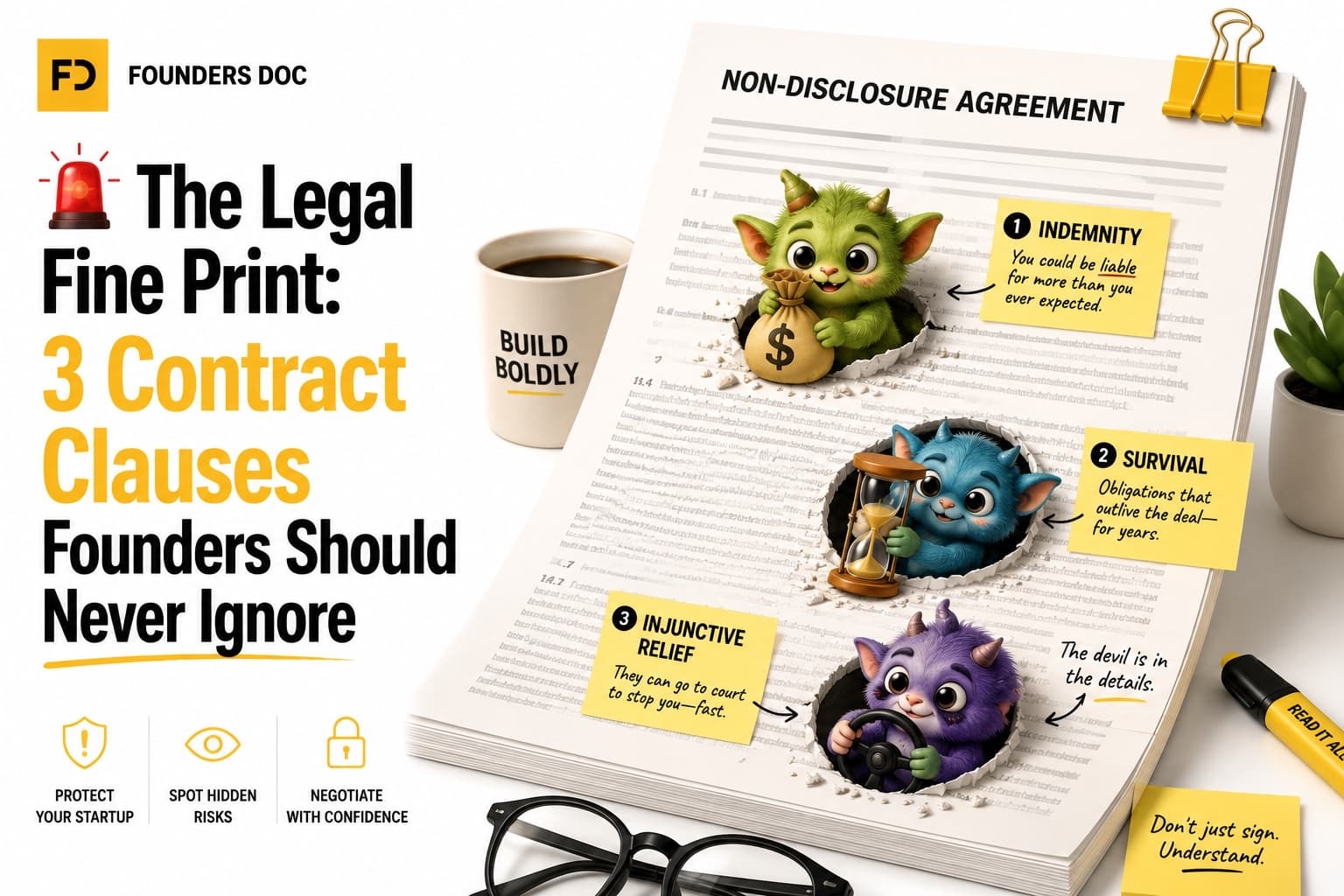
Early-stage founders often sign once the commercial terms look right — price, scope and timing. The real problems usually sit in the legal fine print buried further down the contract.
By the time founders realise what those clauses actually mean, they have already signed — and lost the leverage to negotiate.
🔍 Hidden contract risks founders don't want to overlook
Early-stage founders often skim the legal wording because the commercial deal feels clear. Price, scope and timing are usually easy to understand. The risk sits in the clauses that come after — the ones that decide what happens if something goes wrong.
Those clauses are not "just boilerplate". They were drafted for the party that sent the contract. The good news: many of the changes founders need are reasonable asks. You just need to know what to look for before you sign.
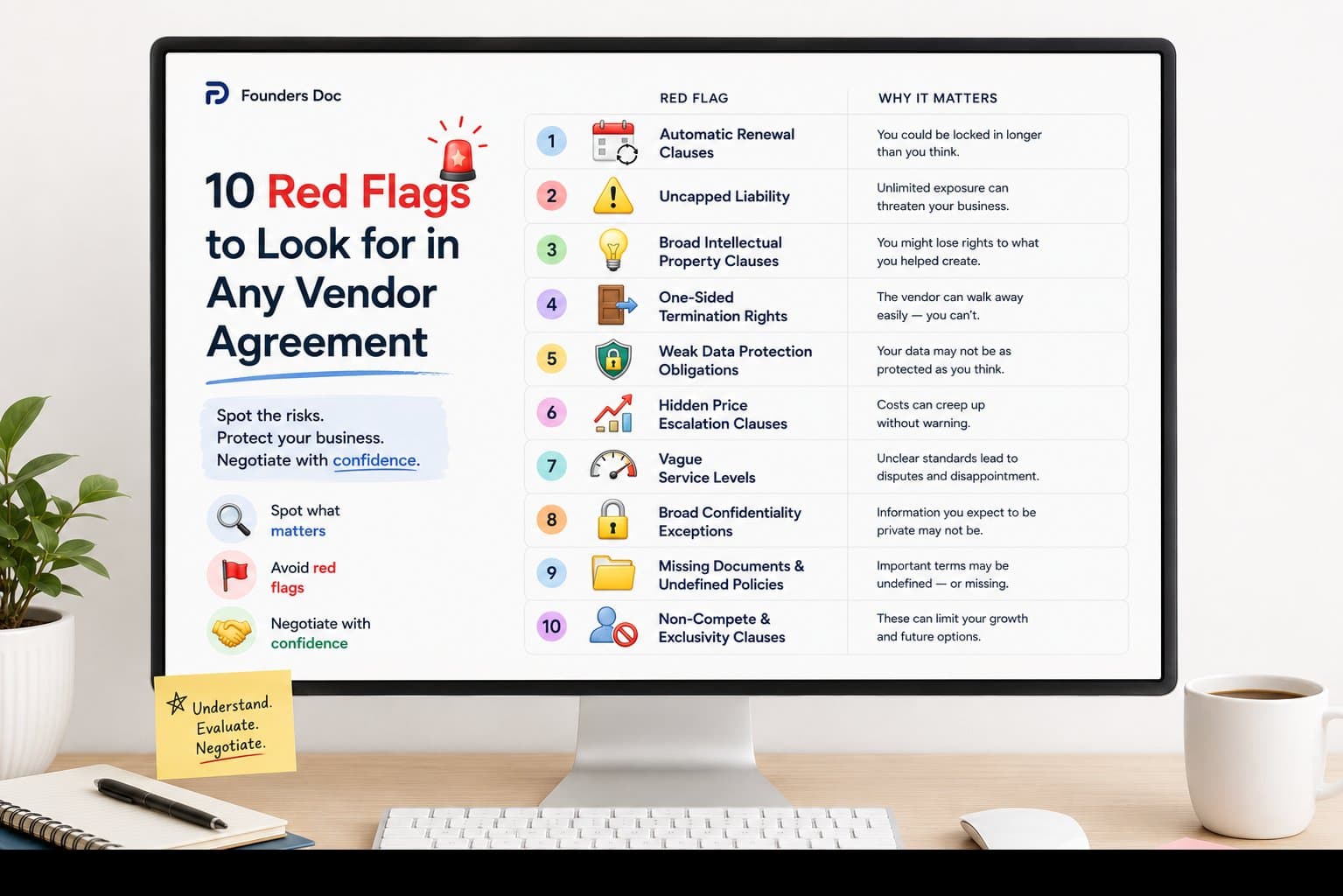
These are three types of clauses founders should not gloss over before signing.
💰 1. Liability caps
Liability caps allocate financial risk when something goes wrong. For startup founders, the key issue is usually not whether the founder can sue the other side — it is whether the startup is taking on liability that could materially exceed the value of the deal.
Founders commonly encounter liability cap issues in investment documents, enterprise customer contracts, data processing agreements, and M&A transactions. Some contracts impose strict caps. Others carve out major risks from the cap. Some agreements do not include a meaningful cap at all.
Even the standard YC SAFE does not include a general liability cap or detailed claims limitation framework. If an investor asks for extra warranties, side letter rights, or investor-specific protections, founders should consider whether a cap is needed to limit future leverage in a later round.
Founders should review the liability position as a whole, not just the headline number:
- 🔢 Quantum caps. Is liability capped at a reasonable amount, or can claims exceed the value of the deal itself?
- ⏳ Time caps. How long can claims be brought after signing or closing?
- 🎯 Scope limitations. Are the obligations narrowly drafted, or are they broad enough to create open-ended exposure?
- 🚪 Carve-outs. Which claims sit outside the cap, such as fraud, wilful misconduct, confidentiality breaches, or data protection breaches?
📌 Example: aggressive warranty exposure in investment documents
"The Company and the Founders, on a joint and several basis, warrant that all information provided or made available to the Investor, whether before or after the date of this Agreement, is true, complete, accurate and not misleading in any respect. The Company and the Founders shall indemnify the Investor against all losses, damages, claims, liabilities, costs and expenses arising directly or indirectly from any breach or alleged breach of the warranties. The Investor shall be entitled to recover, on demand, an amount equal to one hundred and fifty percent (150%) of the Subscription Amount, together with all enforcement costs and legal fees."
Why this matters. At first glance, the fundraising may look straightforward. In practice, broad warranties combined with joint and several liability and enhanced repayment rights can create significant pressure on both the company and the founders long after the round closes. Even relatively minor disclosure disputes may later become leverage points when the startup needs approvals, waivers, or investor cooperation in a future financing round.
Founder-friendly position. A balanced liability clause should keep risk proportionate to the commercial reality of the transaction. Founders should push for:
- reasonable caps on liability amount;
- clear time limits for bringing claims;
- narrowly drafted obligations and warranties;
- liability limited to matters within actual knowledge and control; and
- carve-outs limited to genuinely serious misconduct only.
⚖️ 2. Indemnification
Indemnification is a dollar-for-dollar reimbursement obligation. If a covered loss occurs, the indemnifying party agrees to compensate the other party for that loss, often including legal fees, settlement costs, and third-party claims. In practice, indemnities are not always dramatically different from ordinary damages claims. The real risk is in the drafting.
- 🔁 Procedural advantage. Indemnities can be drafted like debt-style reimbursement obligations, making recovery cleaner and arguments narrower.
- 💸 Legal fees exposure. Indemnities often cover defence costs, settlements, and legal fees.
- 👥 Third-party claims. Indemnities commonly also apply when someone outside the contract sues.
- 🧢 Cap avoidance. Indemnities are often carved out from the liability cap, which can make exposure much larger than expected.
- 🎮 Control issues. Some indemnity clauses let the other side control the defence or settlement process while the startup bears some or all of the legal costs.
📌 Example: broad indemnity language
"The Company shall indemnify, defend and hold harmless the Customer, its affiliates, directors, officers, employees, agents and customers from and against any and all claims, demands, actions, investigations, losses, damages, liabilities, penalties, fines, judgments, settlements, costs and expenses, including full legal fees on an indemnity basis, arising directly or indirectly out of or relating to the Services, the Platform, any data incident, security vulnerability, service interruption, alleged infringement of intellectual property rights, violation of applicable law, or any act, omission, negligence or misconduct of the Company, whether or not finally determined by a court of competent jurisdiction."
Why this matters. This clause is drafted extremely broadly. The startup is not just covering proven breaches of contract — it may also be responsible for investigations, allegations, regulatory issues, security incidents, third-party claims, and legal costs arising "directly or indirectly" from the services. The obligation to "defend" can also require the startup to fund legal costs from the start of a dispute, before liability has been established. If the indemnity sits outside the liability cap, the startup's exposure may become disproportionate to the value of the deal.
Founder-friendly position. A balanced indemnity clause should:
- apply only to specific and clearly defined risks;
- be tied to losses actually caused by the startup's breach, negligence, or misconduct;
- sit within the liability cap where possible;
- exclude remote, indirect, or speculative claims;
- require the customer to mitigate losses; and
- give the startup reasonable control over the defence, legal counsel, and settlement process.
🔁 3. Termination & auto-renewal terms
This is the clause where you lose the ability to leave. Auto-renewal and termination clauses decide whether a startup can leave a contract when the arrangement stops making commercial sense. For founders, the risk is practical. A startup may outgrow an office, stop using a tool, change its operating model, or need to reduce costs — and the contract may still keep it locked in.
📅 Notice window traps
Some contracts require notice of non-renewal months before the term ends. If the founder misses the deadline, the contract may renew automatically.
Termination for cause vs termination for convenience
- Termination for cause allows a party to exit only if the other side commits a serious breach.
- Termination for convenience allows a party to exit for any reason by giving notice.
Founders should not assume they can stop using a product, service, or space and walk away. Many contracts require the startup to keep paying until the term ends.
🏢 Example: one-sided tenancy termination language
"This Tenancy Agreement shall automatically renew for a further term of two (2) years unless the Tenant gives written notice of non-renewal at least six (6) months before the expiry of the current term. The Landlord may terminate this Agreement by giving the Tenant thirty (30) days' written notice."
Why this matters. The landlord has a clear exit right, but the tenant does not. If the founder misses the non-renewal deadline, the startup may be locked into another multi-year lease. That can be a serious problem if the startup outgrows the space, downsizes, moves to remote work, or needs to cut costs.
Founder-friendly position. Founders should push for clear renewal deadlines, written reminders before renewal, no automatic renewal unless both parties agree, mutual termination rights, and termination for convenience after an initial fixed period.
⏱️ 60-second sense-check before you sign
Run any commercial contract through this checklist before signing:
| Area | Question to ask | Pass if |
|---|---|---|
| 💰 Liability cap | Is the startup's liability proportionate to the size and risk of the deal? | Liability is capped at a reasonable amount, with clear limits on scope, carve-outs, and claim periods. |
| ⚖️ Indemnity | Does the indemnity create exposure beyond the startup's actual fault or control? | Indemnities are narrowly drafted, tied to specific risks, and sit within the liability cap where possible. |
| 🔁 Term and termination | Can the startup realistically exit if the arrangement stops making commercial sense? | No hidden auto-renewal traps, reasonable notice periods, and a practical termination right for the startup. |
If a clause creates disproportionate risk, raise it before signing. Most commercial contracts are negotiable, especially on liability, indemnities, renewal mechanics, and termination rights.
🎯 Key takeaways
- Risk is usually hidden in the mechanics — caps, carve-outs, indemnities, renewal windows, and termination rights matter more than the headline commercial terms.
- Startups should limit downside exposure — especially where contracts create uncapped liability, broad indemnities, or one-sided exit rights.
- "Standard" does not mean harmless — most of these clauses are negotiable before signing, but much harder to fix later.
Run your next contract through FD AI for a contract review. It flags the key issues across the contract and tells you what's worth raising before you sign.
Founder contract reads
More from FD AI

Review your next contract with Jessica.
Know what you’re signing — in minutes, not hours.