🚩 The Hidden Risks in Standard NDAs (And How to Spot Them)
Most founders sign NDAs without reading them closely. A practical guide to the seven clauses that quietly change your risk — and exactly what to check before you sign.

Most founders sign NDAs without reading them closely. That sounds dramatic, but it happens every day.
You're about to pitch an investor, a customer wants a pilot, a supplier floats a partnership — someone emails over a "standard NDA," calls it a formality, and you sign. That is usually where problems start.
Many NDAs are not actually standard. Some quietly affect your:
- Intellectual property
- Hiring plans
- Future fundraising
- Freedom to talk to other partners
An NDA is one of the first contracts a startup signs — and one of the most misunderstood. Good review isn't about negotiating every line. It's about spotting the few clauses that actually change your risk.
This guide covers the 7 hidden risks that frequently appear in NDAs — why they matter commercially, and what to look for before signing. Built for founders, operators, and in-house legal teams.
🚩 The 7 hidden risks at a glance
- An overly broad "Confidential Information" definition
- Restrictions that go beyond disclosure
- Weak intellectual property protection
- Unrealistic return-and-destruction obligations
- A confidentiality period that lasts forever
- One-sided disclosure rights
- Coverage of future information you've never seen
📌 First: what is an NDA actually for?
A Non-Disclosure Agreement exists for a simple reason: one party wants to share confidential information without worrying it will be misused or leaked. A well-drafted NDA should define what information is confidential, explain how it can be used, require reasonable protection of that information, and set out what happens when the relationship ends.
⚠️ When an NDA starts regulating hiring, product development, ownership rights, business strategy, or future opportunities — slow down and read more carefully.
🔍 1. The definition of "Confidential Information" is too broad
This is the most common problem. Many NDAs define Confidential Information as "any information disclosed by a party, whether oral, written, electronic or otherwise." At first glance that sounds reasonable — but it can capture almost everything.
Imagine you meet a potential partner for coffee. They casually mention market trends, customer preferences, or general industry observations. Months later, your company launches a product based on your own research, and the other party claims you used their confidential information. Could they prove it? Maybe not. Would you want the argument? Definitely not.
💡 Example
A founder discusses broad ideas about digital transformation with a large corporate — no detailed technology disclosed. Six months later, they launch a feature solving a similar problem. A poorly drafted NDA leaves room for allegations the feature was based on confidential information — a distraction clearer drafting would have prevented.
| 🔍 What to look for | ✅ Better position |
|---|---|
| A definition that captures everything | Excludes publicly available information |
| No carve-outs for prior knowledge | Excludes information already known to the recipient |
| No carve-out for your own R&D | Excludes independently developed information |
| No lawful-source exception | Excludes information lawfully obtained elsewhere |
🚫 2. The NDA restricts more than disclosure
Some NDAs quietly include non-compete or exclusivity language. The confidentiality obligations look normal, but buried elsewhere you may find wording that prevents you from working with competitors, discussing similar projects with other parties, or pursuing opportunities in the same market.
That is no longer just an NDA — it is starting to influence your commercial freedom. Startups survive by keeping options open: several customers, multiple investors, different partners at once. An NDA should protect information, not block legitimate discussions.
| 🔍 Watch for these phrases | ✅ Better position |
|---|---|
| "Exclusive discussions" / "sole negotiation rights" | No exclusivity unless commercially justified |
| "Restricted activities" | Confidentiality terms only — no activity restrictions |
| "Non-compete" / "non-circumvention" | Handled separately, not assumed into a "standard" NDA |
💡 3. Weak intellectual property protection
This is where founders often get caught out. Some NDAs contain broad language on ideas, feedback, improvements, or developments — wording that hands any suggestion arising from discussions to the disclosing party.
Most startups are built around IP. You don't want a single customer conversation creating uncertainty over ownership of your software, algorithms, workflows, or product roadmap.
💡 Example
You demo your AI workflow to a customer, who suggests an improvement. Your team later develops that feature independently. A poorly drafted NDA lets the customer argue it owns the improvement — because the idea "originated" in discussions.
| 🔍 What to look for | ✅ Better position |
|---|---|
| Broad ownership of "improvements" | Each party retains its existing IP |
| Discussions transferring rights | Discussions transfer no ownership |
| Ambiguity over independent work | Independently developed tech stays with the developer |
🗑️ 4. The return and destruction obligations are unrealistic
Many NDAs require the recipient to "delete or destroy all confidential information immediately upon request." Sounds straightforward. In reality, it often isn't. Modern businesses rely on automated backups, cloud storage, and email archives.
| 🔍 What to look for | ✅ Better position |
|---|---|
| Absolute "delete everything" wording | Carve-outs for backup systems and archived copies |
| No allowance for compliance needs | Exceptions for legal retention requirements |
| Ignores how systems actually work | Allowance for records in ordinary business systems |
⏳ 5. A confidentiality period that lasts forever
Not all information deserves perpetual protection. Trade secrets might justify it; ordinary business discussions don't. Yet some NDAs run indefinitely, regardless of the information involved. Five years from now your business may look completely different — you don't want stale, low-value information still locked under obligation.
| ⚠️ Information type | 💡 Typical approach |
|---|---|
| Trade secrets | Long-term or indefinite protection |
| Commercial information | Fixed period (e.g. 2–5 years) |
| General discussions | Limited protection period |
The right duration is deliberate, not automatic.
🔁 6. One-sided disclosure rights
Many founders focus only on their own obligations — but check what the other side can do. Some NDAs give one party broad rights to disclose information to affiliates, consultants, contractors, or advisers, while your rights stay heavily restricted.
The more people who receive confidential information, the greater the leak risk. Obligations should be balanced.
| 🔍 What to look for | ✅ Better position |
|---|---|
| Broad affiliate / adviser sharing | Clear limits on who can receive information |
| Asymmetric rights | Equivalent rights for both parties |
| Unbound recipients | Recipients must also comply with confidentiality |
📭 7. The NDA covers future information you have never seen
Some agreements define Confidential Information so broadly it includes future information not yet disclosed. Harmless-sounding — until the scope blurs.
💡 Example
You sign today. Over two years, the other party sends scattered emails, presentations, and documents, all "automatically" confidential. Nobody labels anything. Nobody keeps records. Nobody remembers what was disclosed. A dispute arises — and no one can say what was actually protected.
| 🔍 What to look for | ✅ Better position |
|---|---|
| Everything "automatically" confidential | Information clearly identified as confidential |
| No record of oral disclosures | Oral disclosures confirmed in writing afterwards |
⚖️ Not every NDA is high risk
Keep perspective. Many NDAs are perfectly reasonable, and a straightforward mutual NDA between two businesses is usually low risk.
The goal isn't to negotiate every sentence — it's to catch provisions affecting ownership, commercial flexibility, future growth, or compliance.
Most founders don't need a 20-page legal memo. They need to know where the real risks sit.
📋 A simple NDA review checklist
Before signing, check:
| 🔎 Issue | ✅ Quick check |
|---|---|
| Definition | Is "Confidential Information" defined clearly? |
| Exclusions | Are public and independently developed info excluded? |
| Restrictions | Any exclusivity or non-compete language? |
| IP | Is your intellectual property protected? |
| Deletion | Are deletion obligations realistic? |
| Duration | Is the confidentiality period reasonable? |
| Disclosure | Are disclosure rights balanced? |
| Certainty | Can you tell what's actually protected? |
If you cannot answer these confidently, the NDA needs another look.
🚀 Final takeaway
Most NDA problems don't come from one shocking clause.
They come from ordinary-looking provisions nobody paid attention to at the start.
A short review focused on the right issues saves a huge amount of legal and commercial pain later. That's why more teams now adopt AI-assisted contract review — legal AI is especially good at spotting recurring risk patterns quickly and consistently.
Run your next NDA through FD AI. It flags hidden risks, explains clauses in plain English, and gives you a fast first pass before legal steps in — so you may spot a problem before it becomes an expensive one.
Founder contract reads

More from FD AI

📊 What Founders Miss in their SAFE
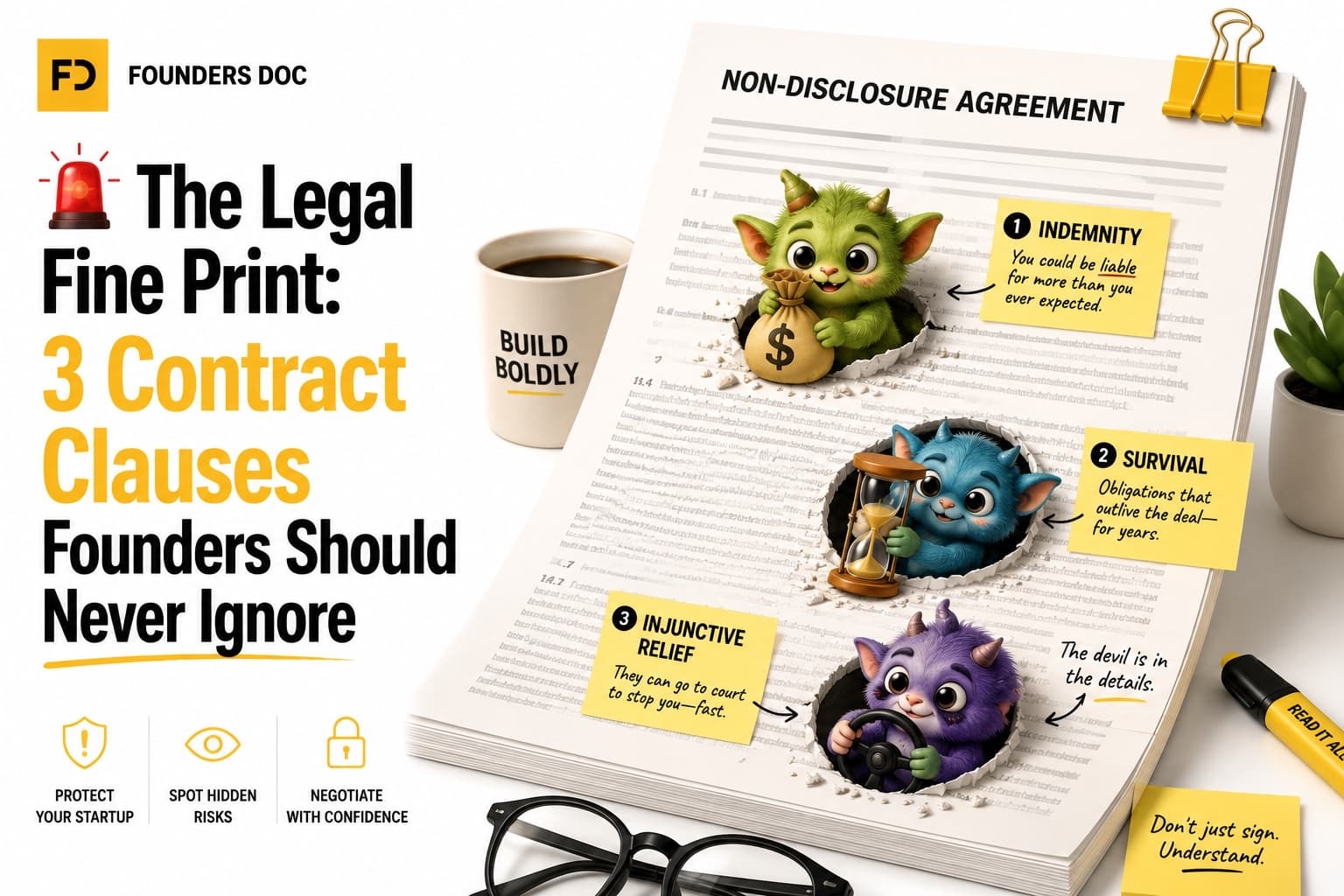
🚨 The Legal Fine Print: 3 Contract Clauses Founders Should Never Ignore
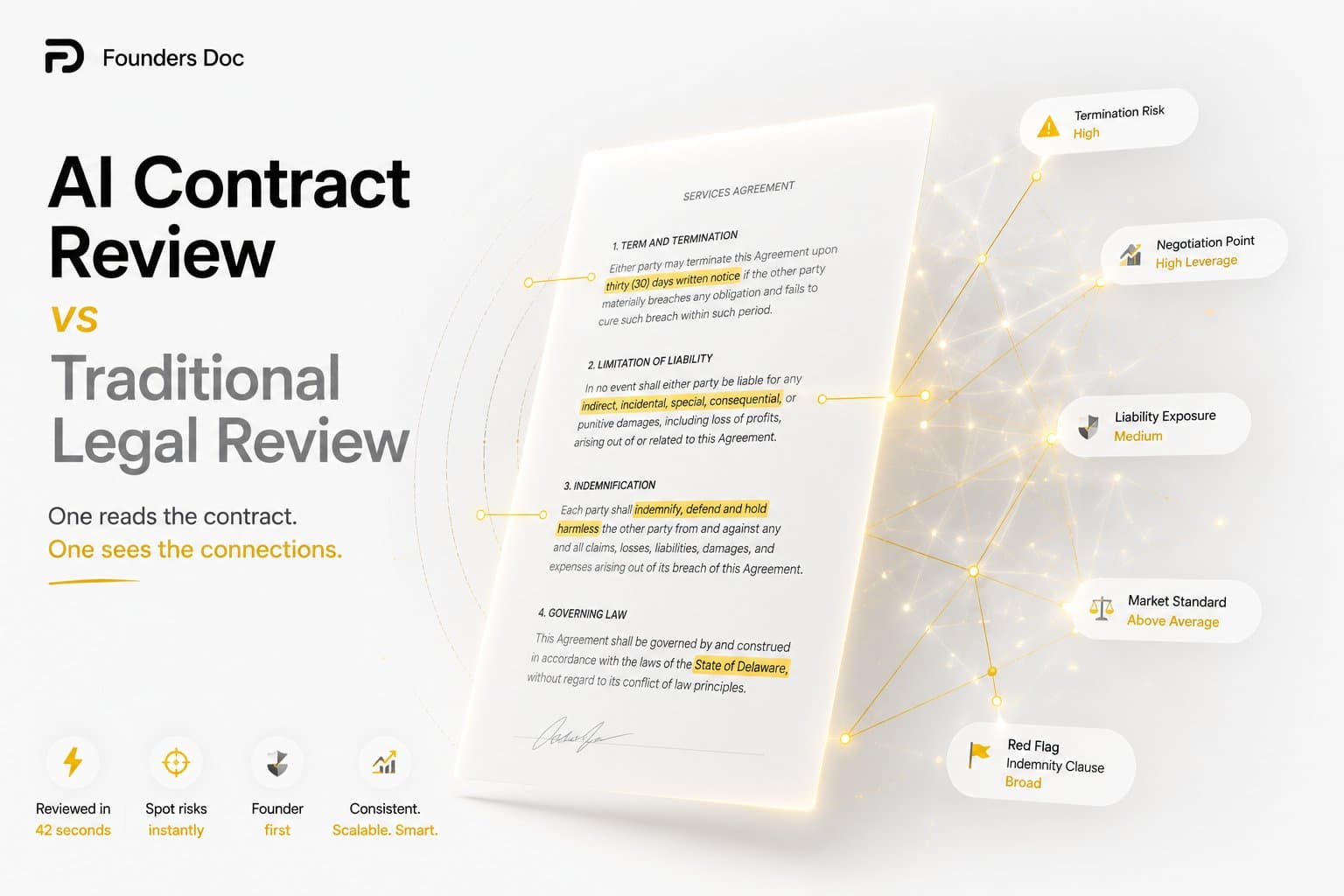
⚖️ AI Contract Review vs Traditional Legal Review: What's the Difference?
Review your next contract with Jessica.
Know what you’re signing — in minutes, not hours.