⚖️ AI Contract Review vs Traditional Legal Review: What's the Difference?
A founder's guide to the difference between AI contract review and traditional legal review — what AI does well, where lawyers still matter, and how smart startup teams combine both.
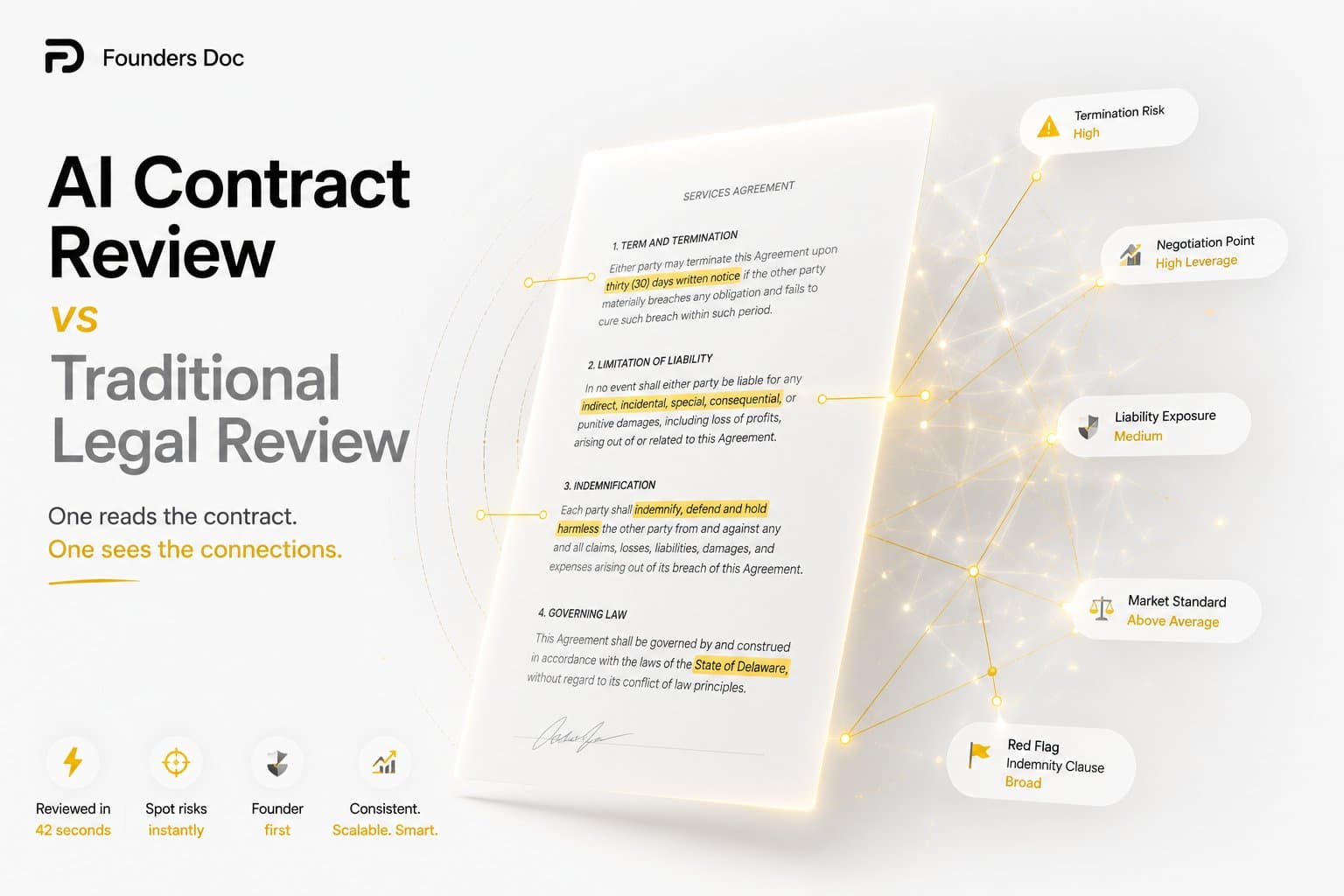
😩 Why Founders Dread Contracts
Most founders do not enjoy reviewing contracts. You just want to close the deal, hire the employee, onboard the vendor, or get the transaction signed.
But contracts can create problems quietly. For example:
- the agreement renews automatically for another year;
- the customer gets rights over your product improvements;
- the liability clause has no cap; or
- the contract says you must do something your team cannot realistically do.
🤖 Where AI Contract Review Comes In
This is where AI contract review helps. It gives you a faster first look at the agreement. It can summarise the key terms, flag common risks, and show you where you may need a closer legal review.
That does not mean AI replaces lawyers. It means founders can understand contracts faster, ask better questions, and work out which documents need a lawyer’s attention and which do not.
⚖️ AI vs Lawyers: The Simple Version
So what is the actual difference between AI contract review and traditional legal review? The simplest way to think about it is this:
AI helps you spot the issues faster. Lawyers help you decide what to do about them.
🤖 What AI Contract Review Actually Does Well
AI contract review tools help people understand contracts faster.
⚙️ What a Legal AI Platform Can Do
In practical terms, a legal AI platform can:
- summarise an agreement in minutes;
- flag unusual clauses;
- compare the contract against your usual position;
- identify missing protections;
- suggest first-pass markups;
- spot inconsistencies across documents; and
- answer practical questions about the agreement.
For founders, this means less time staring at a 35-page contract and wondering what actually matters. It also means the documents that reach a lawyer are the ones that genuinely need that attention.
📄 Example: A Quick First Look at an NDA
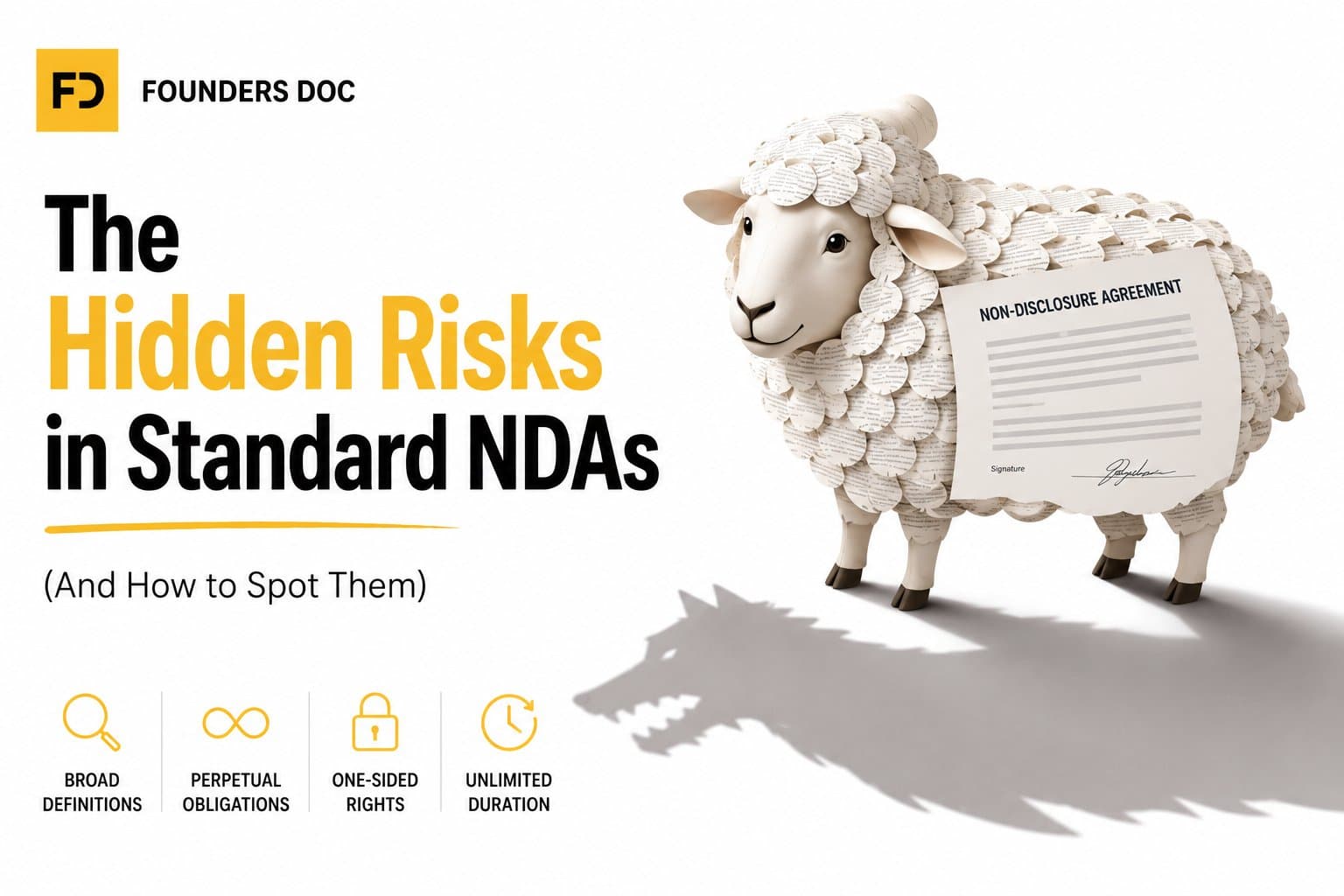
For example, if you receive a standard NDA, AI can give you a quick first view:
- Is the confidentiality period too long?
- Are the obligations one-sided?
- Is there anything unusual about IP, liability, or non-solicitation?
- Does the contract match what you thought you agreed commercially?
That first view is useful. It helps you decide whether the contract is low-risk, needs a few comments, or should be escalated for legal review.
AI is especially helpful where the contract is routine, repetitive, or similar to documents you have reviewed before. That is exactly where AI contract review performs well.
⚡ Why Startups Are Adopting Legal AI So Quickly
Most startups are dealing with more contracts than they expected. As the business grows, contracts start appearing everywhere:
| Contract Type | Why It Slows Teams Down |
|---|---|
| NDAs | High volume and repetitive |
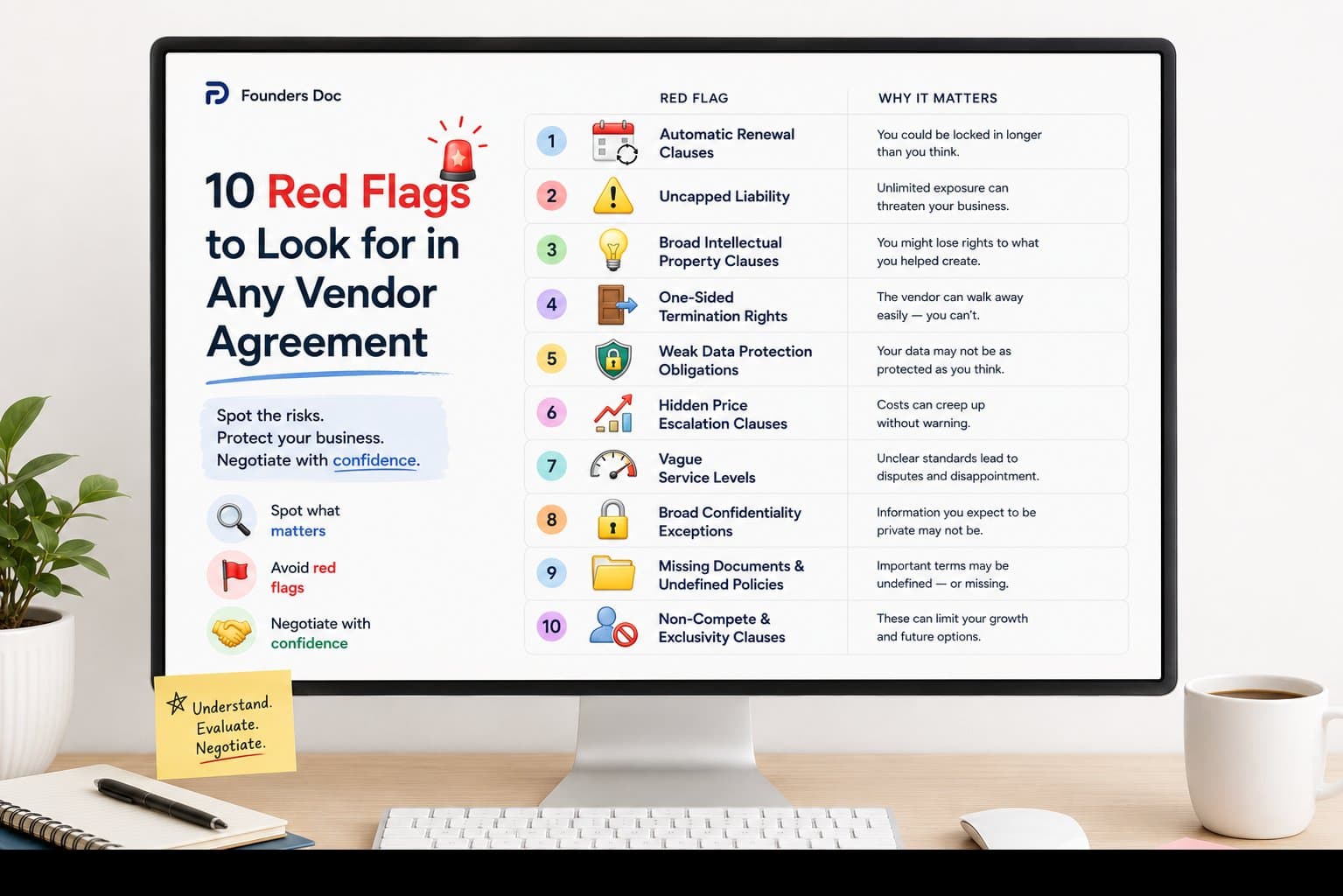
| Vendor agreements | Hidden liability and auto-renewals |
| SaaS contracts | Long customer negotiation cycles |
| Employment agreements | Compliance inconsistencies |
| DPAs | Technical and privacy-heavy drafting |
| Partnership agreements | Commercial ambiguity |
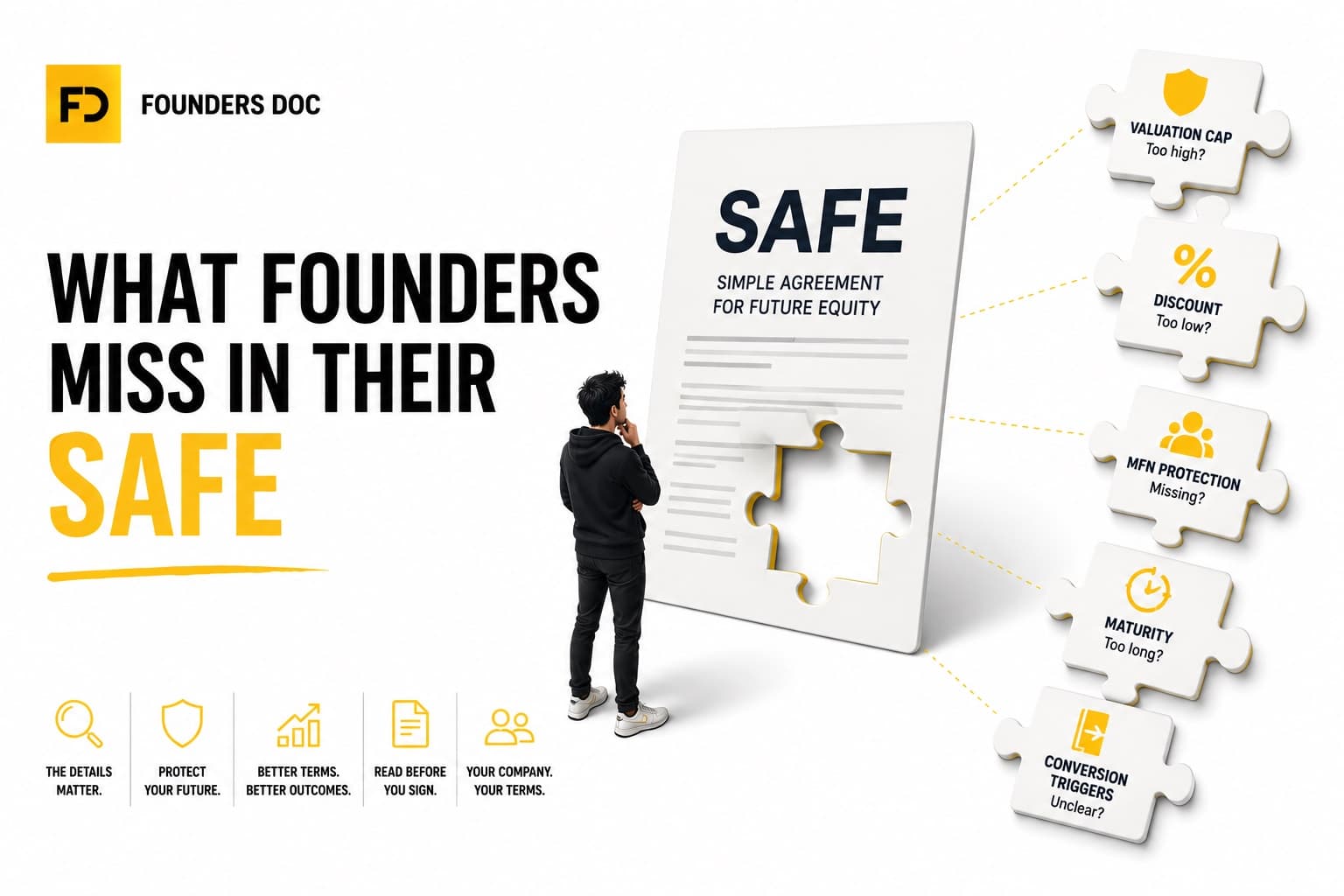
| Investment documents | High-impact negotiation points |
The problem is not just legal cost. It is operational bottlenecks. When contracts sit in review for too long:
- sales cycles slow down;
- procurement gets delayed;
- founders approve risky terms under pressure; and
- legal becomes the team everyone is waiting on.
AI contract review helps reduce that friction. A founder can upload a contract, get a quick summary, identify obvious red flags, and decide whether the agreement needs deeper legal review. That speed matters.
🧠 The Biggest Difference: AI Spots Patterns, Lawyers Make Judgments
This is the core distinction. AI is excellent at recognising patterns across contracts. Lawyers are responsible for deciding what those patterns actually mean for the business.
🛡️ Example: An Uncapped Liability Clause
For example, an AI tool may correctly flag that a limitation of liability clause is uncapped. That is useful. A lawyer usually goes further and asks:
- Is the risk commercially justified?
- Does insurance cover this exposure?
- Is this common in this industry?
- Is the customer important enough to accept the risk?
- Can we narrow the clause instead of deleting it?
- What fallback position is realistic?
Those are business judgment questions, not just legal drafting questions.
📐 Example: A Broad IP Clause
The same thing happens with IP clauses. AI may identify broad assignment wording. A lawyer will usually assess whether the clause accidentally transfers:
- background IP;
- independently developed technology;
- future improvements;
- internal tooling; or
- product know-how.
That commercial context is where traditional legal review still matters a lot.
📑 Where AI Contract Review Works Extremely Well
There are already areas where AI is genuinely very useful.
🔍 1. First-Pass Contract Reviews
This is probably the strongest use case today. Instead of spending 45 minutes reading a standard NDA, founders or legal teams can get:
- a quick summary;
- key risk areas;
- unusual provisions;
- missing clauses; and
- suggested markups.
That does not replace legal review. It helps teams decide whether the contract actually needs deeper legal attention. For routine agreements, that can save a huge amount of time.
📚 2. Internal Playbook Reviews
Many companies already have internal legal rules such as:
- no uncapped liability;
- Singapore governing law preferred;
- payment terms capped at 45 days;
- IP ownership stays with the company;
- assignment requires consent.
AI tools are very good at comparing agreements against these playbooks consistently. That consistency becomes valuable when contract volume increases. By the tenth MSA of the week, AI keeps applying the playbook evenly. That frees up lawyers to focus their attention where judgment is genuinely needed.
⏱️ 3. High-Volume Contract Work
AI performs especially well when agreements are repetitive. Examples include:
- NDAs;
- procurement agreements;
- employment contracts;
- DPAs;
- standard vendor agreements; and
- customer SaaS terms.
If the business reviews similar contracts repeatedly, AI can dramatically reduce turnaround times. That is why many in-house teams now treat AI as part of their operational workflow rather than an “experimental” tool.
📝 4. Contract Summaries for Non-Lawyers
Most founders do not want a 12-page legal memo. They want answers like:
- Can we terminate easily?
- Are we giving away IP?
- Is there auto-renewal?
- What happens if payment is late?
- Can the other side change pricing?
- Are there exclusivity restrictions?
AI tools are becoming very good at generating these practical summaries quickly. That makes legal review more accessible for operators and founders who are not legally trained.
⚖️ Where Traditional Legal Review Still Matters Most
AI is improving quickly, but there are still areas where experienced legal judgment matters heavily.
🏛️ 1. Fundraising and Shareholder Agreements
These documents shape:
- ownership;
- board control;
- investor rights;
- founder vetoes;
- liquidation economics; and
- exit outcomes.
AI can identify the clauses. It still struggles to fully assess negotiation leverage and investor dynamics. For example, a board veto right may be acceptable in one financing round and commercially dangerous in another. That assessment depends on:
- bargaining power;
- company stage;
- investor profile;
- future fundraising strategy; and
- the broader deal structure.
Those are contextual decisions.
💡 2. IP Ownership and Licensing
This area creates problems surprisingly often for startups. A broad IP assignment clause may accidentally transfer:
| Issue | Why It Matters |
|---|---|
| Background IP | Protects pre-existing technology |
| Improvements | Prevents future ownership disputes |
| Licence scope | Controls how the technology can be used |
| Exclusivity | Affects future partnerships and customers |
| Derivative works | Impacts future product rights |
| Sublicensing | Affects commercial scalability |
AI can flag these concepts. A lawyer helps determine whether the actual commercial outcome is acceptable.
🤝 3. Negotiation Strategy
This is one area where human judgment still matters heavily. Contracts are negotiated between people, not just clauses. Sometimes a legal point is technically weak but commercially sensitive. Sometimes the startup has leverage. Sometimes speed matters more than perfect drafting. Sometimes preserving the relationship matters more than winning every clause.
Experienced lawyers understand:
- which issues actually matter;
- where compromise is acceptable;
- when to escalate; and
- how to negotiate without slowing the deal unnecessarily.
AI still struggles with that practical balance.
🚨 4. Ambiguous or Messy Agreements
Real-world contracts are often messy. They contain:
- inconsistent definitions;
- broken cross-references;
- vague drafting;
- missing schedules;
- handwritten edits; or
- conflicting obligations.
AI tools still perform best when contracts are relatively structured and clean. Human lawyers are much better at resolving ambiguity and identifying drafting intent when the agreement itself is poorly written.
💸 Is AI Contract Review Cheaper?
Usually, yes. But the real value is not “free legal advice”. The value is reducing repetitive legal work before it reaches external counsel. For example:
| Task | 🤖 AI Review | 👩🏻⚖️ Lawyer Review |
|---|---|---|
| Standard NDA | Quick first pass | Worth a check before signing |
| Vendor agreement | Strong first-pass review | Valuable for negotiation and liability |
| DPA review | Great with playbooks | Key for major deviations and compliance |
| Employment contract | Quick first review | Important for local compliance advice |
| Shareholder agreement | Helpful starting point | Strongly recommended |
| M&A transaction | Useful for early triage | Essential throughout |
The strongest legal teams are not choosing between AI and lawyers. They are using AI to make lawyers faster and more efficient. That combination is where the operational advantage sits.
🏢 What Smart Startup Teams Are Actually Doing
The most effective workflow today usually looks like this:
⚡ Step 1 — AI First Pass
The founder, ops team, or in-house legal team uploads the agreement into a legal AI platform. The system:
- summarises the contract;
- flags risky clauses;
- compares against internal standards; and
- prepares suggested revisions.
👩🏻⚖️ Step 2 — Human Legal Review
A lawyer reviews:
- negotiation leverage;
- material risk allocation;
- commercial implications;
- investor sensitivities;
- enforceability concerns; and
- practical business impact.
🚀 Step 3 — Founder Decision
The founder decides:
- what risk is acceptable;
- whether speed matters more than leverage;
- where to negotiate; and
- whether the commercial upside justifies compromise.
That workflow is significantly faster than relying on traditional review alone. It is also much safer than relying purely on AI.
🚨 The Biggest Mistake Founders Make With Legal AI
The biggest problem is usually not hallucinations. It is overconfidence. AI tools can sound extremely convincing even when they miss commercial context. For example:
- a clause may technically be enforceable but commercially unreasonable;
- a low-probability issue may still carry massive downside;
- a missing schedule may contain the most important obligations;
- a “market-standard” clause may still create operational problems for your business.
AI review should help founders ask better questions. It should not create false confidence that legal judgment is unnecessary.
📊 AI Contract Review vs Traditional Legal Review
| 🗂️ Area | 🤖 AI Contract Review | 👩🏻⚖️ Traditional Legal Review |
|---|---|---|
| ⚡ Speed | Extremely fast | Slower |
| 💰 Cost | Lower | Higher |
| 🧠 Commercial judgment | Limited | Strong |
| 🌐 Context awareness | Limited | High |
| 📚 High-volume reviews | Excellent | Resource-intensive |
| 🤝 Complex transactions | Limited | Essential |
| 🚩 First-pass issue spotting | Excellent | Excellent |
| 🧭 Founder guidance | Basic | Strong |
| 💬 Relationship management | None | Important |
✅ Practical Takeaways for Founders
Before signing your next agreement:
- Use AI tools for quick first-pass contract reviews.
- Escalate agreements involving ownership, liability, investor rights, or exclusivity.
- Treat AI summaries as operational support, not final legal advice.
- Ask whether your team can realistically comply with the obligations in the agreement.
- Prioritise lawyer review for contracts affecting control, fundraising, IP, or major commercial exposure.
🚀 Final Thoughts
✨ What’s Changing
AI contract review is already changing how startups handle legal work. It helps founders move faster, gives lean legal teams more capacity, and reduces time spent on repetitive review tasks. That does not mean lawyers disappear. It means legal teams can spend less time on repetitive review and more time on the advice that shapes the business.
🤝 The Winning Combination
The best startup legal workflows now combine:
- 🤖 AI for speed and operational efficiency; and
- 👩🏻⚖️ lawyers for judgment, negotiation, and strategic advice.
That combination is where founders usually get the best outcome.
Run your next contract through FD AI for a fast first-pass review — a summary, the key risks, and suggested markups in minutes, before legal steps in.
Founder contract reads
More from FD AI
Review your next contract with Jessica.
Know what you’re signing — in minutes, not hours.