⚖️ A Founder's Guide to Limitation of Liability Clauses
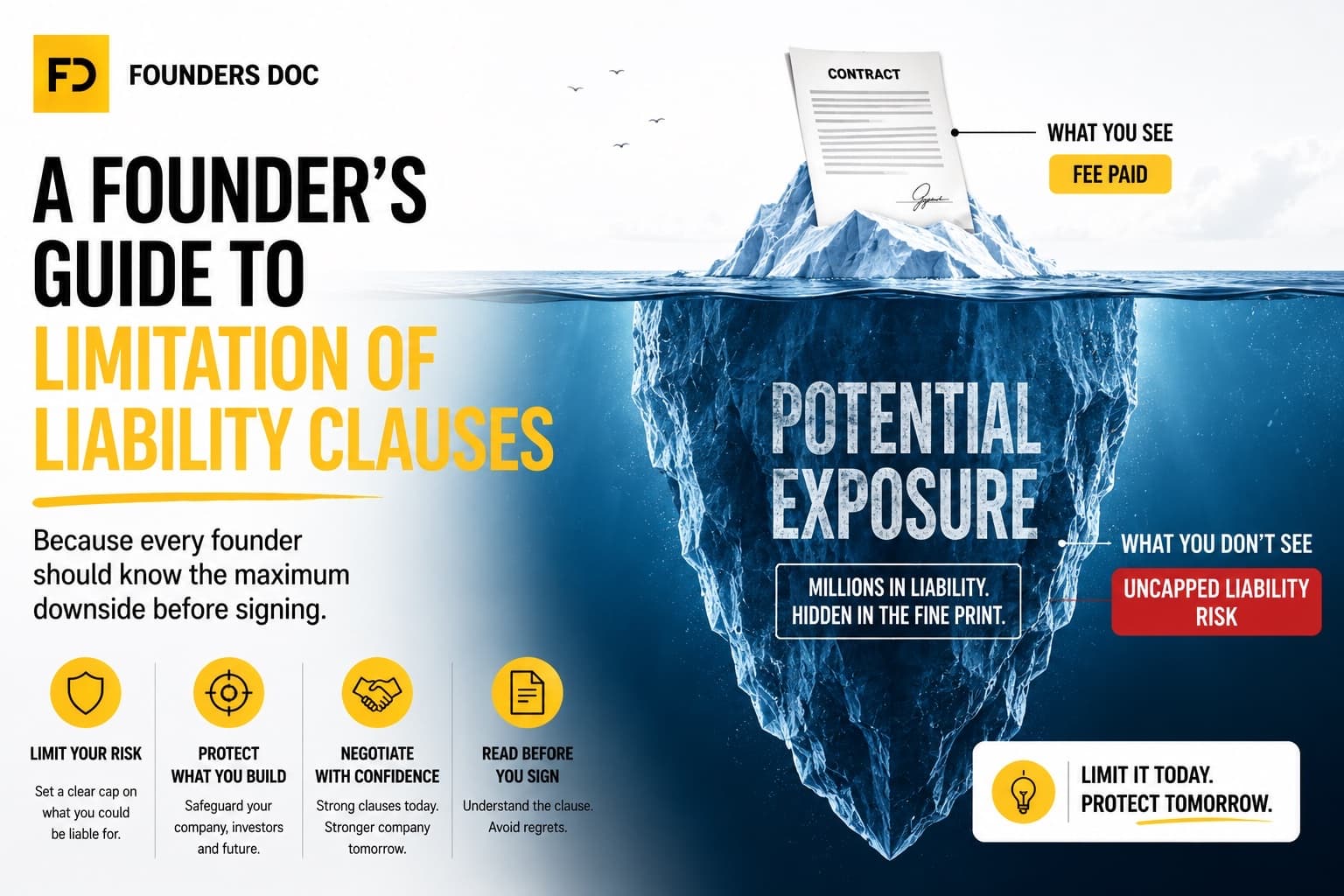
The clause that decides who pays when things go wrong — and how to read it before you sign.
Most founders spend more time negotiating pricing than liability. That is understandable — pricing is easy to see. Liability often sits halfway through a contract in dense legal language that most people skim past.
The problem is that the liability clause often determines what happens when things go wrong. And eventually, something usually does:
- A customer claims your software caused a loss
- A supplier misses a critical deadline
- A contractor accidentally deletes data
- A platform outage disrupts operations
The question then becomes simple:
Who pays?
That answer is usually hidden inside the limitation of liability clause. For startups, this can be one of the most important provisions in any commercial agreement. A well-drafted clause can protect your company from a claim that threatens its survival. A poorly drafted one can expose you to risks that far exceed the value of the deal itself.
👇 This guide explains how limitation of liability clauses work, the red flags founders should watch for, and what positions are typically worth negotiating. Built for founders, operators, and anyone signing commercial contracts.
🚩 The 6 red flags at a glance
- Unlimited liability
- The cap is too high for the deal
- One-sided liability limits
- Broad IP infringement exposure
- Confidentiality carve-outs without limits
- Data protection liability
🤔 What is a limitation of liability clause?
A limitation of liability clause sets a maximum amount that one party can be required to pay if things go wrong. Think of it as a contractual risk allocation tool. Instead of leaving liability completely open-ended, the parties agree in advance how much financial exposure each side will carry.
For example:
| 💥 Scenario | 💰 Potential loss |
|---|---|
| Customer suffers a minor service interruption | S$5,000 |
| Supplier causes project delay | S$50,000 |
| Data breach leads to multiple claims | S$500,000+ |
| Business-critical system failure | Potentially millions |
Without a limitation of liability clause, exposure can become unpredictable. With one, both parties know the boundaries before signing. That certainty is often just as valuable as the cap itself.
💡 Why founders should care
Imagine your startup signs a S$12,000 annual software contract. A year later, the customer claims your software caused S$2 million in losses.
Whether that claim succeeds is a separate question. The immediate issue is whether your contract limits your exposure. If your liability is capped at the fees paid under the agreement, your maximum exposure may be S$12,000. If liability is uncapped, the conversation becomes much more serious.
This is why experienced investors, legal teams and procurement departments pay close attention to liability provisions. They understand that one badly drafted clause can outweigh years of revenue from the deal.
📌 The three parts every founder should understand
Most limitation of liability clauses contain three separate components — and many founders only look at one.
1️⃣ The liability cap
The cap sets the maximum amount recoverable. Common examples include:
| 📐 Cap structure | 🔢 Example |
|---|---|
| Fees paid under agreement | 100% of fees paid |
| Multiple of fees | 2x or 3x fees paid |
| Fixed monetary amount | S$100,000 |
| Different caps for different claims | Variable |
A customer agreement worth S$20,000 per year might contain a cap of:
"The Supplier's aggregate liability shall not exceed the fees paid during the twelve months preceding the claim."
That means the maximum exposure would generally be S$20,000. The higher the cap, the more risk you carry. The lower the cap, the more risk shifts to the other party.
2️⃣ Excluded losses
This is often more important than the cap itself. Many contracts exclude certain categories of losses entirely. Common exclusions include:
- Indirect losses
- Consequential losses
- Loss of profits
- Loss of revenue
- Loss of business opportunities
- Loss of goodwill
Why does this matter? Because these categories often represent the largest claims. Imagine your software experiences an outage and the customer claims:
- S$5,000 in direct remediation costs; and
- S$500,000 in lost sales.
If loss of profits is excluded, the larger claim may fall away. If it is not excluded, exposure can increase dramatically.
3️⃣ Liability carve-outs
Almost every contract contains exceptions to the liability cap. These are known as carve-outs — the parties agree that certain conduct is too serious to benefit from the cap. Common carve-outs include:
| 🪓 Typical carve-out | ❓ Why it exists |
|---|---|
| Fraud | Public policy concerns |
| Wilful misconduct | Deliberate wrongdoing |
| Death or personal injury | Often legally required |
| Confidentiality breaches | Sensitive information risk |
| IP infringement | High-value commercial risk |
| Data protection breaches | Regulatory exposure |
This is where many founders get surprised. They negotiate a liability cap and assume it applies universally. Then they discover half the important claims sit outside the cap altogether.
🚩 Red flag #1: Unlimited liability
The biggest red flag is usually the simplest: no cap. Some agreements either contain no liability limitation clause, or expressly state liability is unlimited. This creates uncertainty from day one.
📋 Example
A startup signs a pilot agreement worth S$15,000 with no liability cap. A dispute arises, and the customer's alleged losses exceed S$1 million. Whether those losses are recoverable becomes a complex legal question.
The startup now faces litigation exposure completely disconnected from the value of the contract — not a position most founders want to be in.
🚩 Red flag #2: The cap is too high for the deal
Not all caps are reasonable. Some agreements contain caps that appear limited but are still commercially aggressive. Consider the following:
| 📄 Contract value | 🧮 Liability cap |
|---|---|
| S$20,000 | S$20,000 |
| S$20,000 | S$40,000 |
| S$20,000 | S$100,000 |
| S$20,000 | Unlimited |
One of these is very different from the others. The right cap depends on the industry, the nature of the services, the risk profile, and bargaining power.
The key question is simple:
Does the exposure make sense compared to the value of the deal? If not, negotiate.
🚩 Red flag #3: One-sided liability limits
Some contracts protect one party but not the other. For example:
The supplier's liability is capped at fees paid.
Meanwhile:
The customer's liability is unlimited.
This is more common than founders realise. Large enterprises often use liability provisions to shift risk down the supply chain. That does not automatically make the clause unacceptable — it does mean you should understand the commercial trade-off before signing.
🚩 Red flag #4: Broad IP infringement exposure
Many contracts carve intellectual property claims out of the liability cap. Sometimes that makes sense. Sometimes the carve-out is drafted far too broadly.
📋 Example
The agreement states:
All claims relating to intellectual property are uncapped.
The wording does not distinguish between:
- Deliberate infringement
- Third-party allegations
- Customer misuse
- Minor disputes over ownership
That can create significant exposure. IP carve-outs should usually be tailored to the actual risk.
🚩 Red flag #5: Confidentiality carve-outs without limits
Confidentiality breaches are frequently excluded from liability caps. Again, this is not necessarily unreasonable. The issue arises when the wording becomes unlimited.
Imagine a junior employee accidentally emails confidential information to the wrong recipient. The disclosure is immediately contained. The actual harm is limited. Yet the contract creates theoretically unlimited liability.
The legal position may be more nuanced than that, but the contractual exposure is still worth examining carefully.
🚩 Red flag #6: Data protection liability
As companies become more data-driven, data protection provisions are receiving greater scrutiny. Customers increasingly request:
- Uncapped privacy liability
- Uncapped cybersecurity liability
- Uncapped regulatory exposure
Founders should approach these requests carefully. A startup handling customer data may accept higher exposure than a company supplying office furniture. The allocation of risk should match the nature of the service.
🏢 What is market practice?
Founders often ask: "What is market standard?" The answer depends heavily on the deal. A SaaS agreement looks different from a consulting agreement. An enterprise customer looks different from a startup customer.
That said, many commercial contracts follow a broad structure:
| 📑 Provision | ⚖️ Common position |
|---|---|
| General liability cap | Fees paid or multiple of fees |
| Indirect losses | Excluded |
| Loss of profits | Excluded |
| Fraud | Uncapped |
| Wilful misconduct | Uncapped |
| Death or personal injury | Uncapped |
| Confidentiality | Negotiated |
| IP claims | Negotiated |
| Data protection | Negotiated |
The important point is not whether a clause is market standard. The important point is whether it is appropriate for your business.
🛠️ Questions to ask before signing
Before accepting a limitation of liability clause, ask:
| ❓ Question | 💡 Why it matters |
|---|---|
| What is the liability cap? | Defines maximum exposure |
| Is the cap tied to fees paid? | Affects commercial proportionality |
| Which losses are excluded? | May remove major claims |
| Which claims sit outside the cap? | Identifies uncapped risks |
| Are both parties treated equally? | Reveals asymmetry |
| Does exposure align with contract value? | Measures commercial reasonableness |
| Can the company realistically absorb the risk? | Tests practical impact |
These questions often reveal more than the drafting itself.
⚖️ Liability clauses are really about risk allocation
Many founders approach negotiations as though one side is right and the other is wrong. That is rarely how liability clauses work. A limitation of liability clause is fundamentally a risk allocation exercise.
The customer wants protection. The supplier wants predictability. Both objectives are reasonable. The challenge is finding a balance that reflects:
- The value of the contract
- The nature of the services
- The practical risks involved
The strongest contracts are usually the ones where both sides understand the risks they are accepting.
🎯 Key takeaways
- Limitation of liability clauses determine who bears financial risk when things go wrong.
- The liability cap is only one part of the analysis.
- Excluded losses and carve-outs often matter more than the cap itself.
- Unlimited liability deserves careful consideration before you sign.
- The value of the contract should influence the level of exposure you accept.
- One-sided liability provisions are common and should be reviewed deliberately.
- Founders should understand every uncapped risk before signing.
🚀 Before you sign the next contract
Many founders review the commercial terms first and leave the liability clause until the end. That is often backwards — a liability clause can have a bigger financial impact than the pricing section.
Before signing your next customer agreement, supplier contract, MSA or SaaS agreement, run it through FD AI Contract Review.
| ✨ What FD AI does | 💡 Why it helps |
|---|---|
| 🚩 Highlights liability caps & carve-outs | See the clauses that actually shift risk |
| 🗣️ Explains key provisions in plain English | Indemnities and confidentiality, demystified |
| ⚡ Reviews before you sign | Understand what you're agreeing to first |
👉 Try FD AI free today — upload your contract and get a plain-English risk review in minutes.
Founder contract reads
More from FD AI
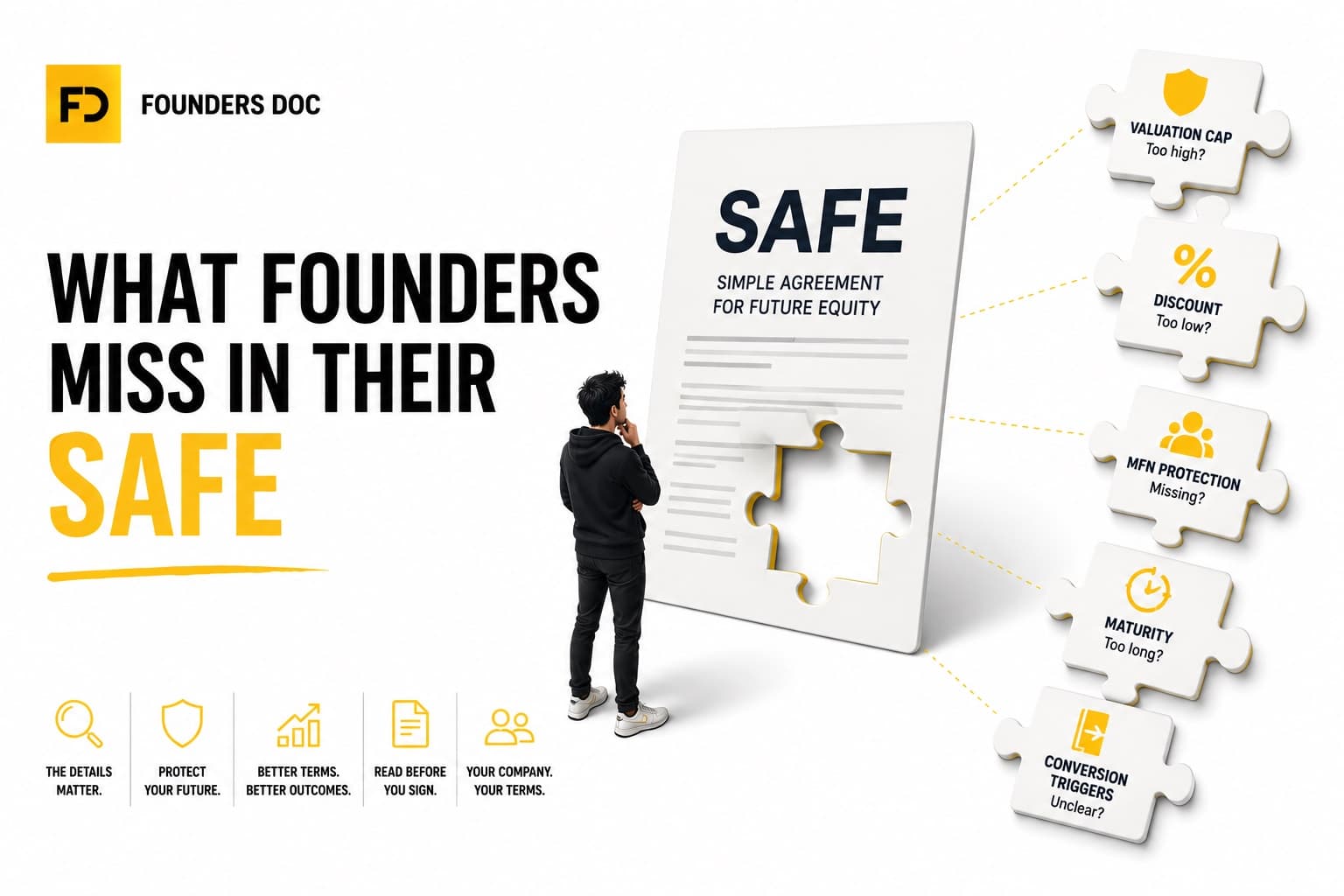
📊 What Founders Miss in their SAFE
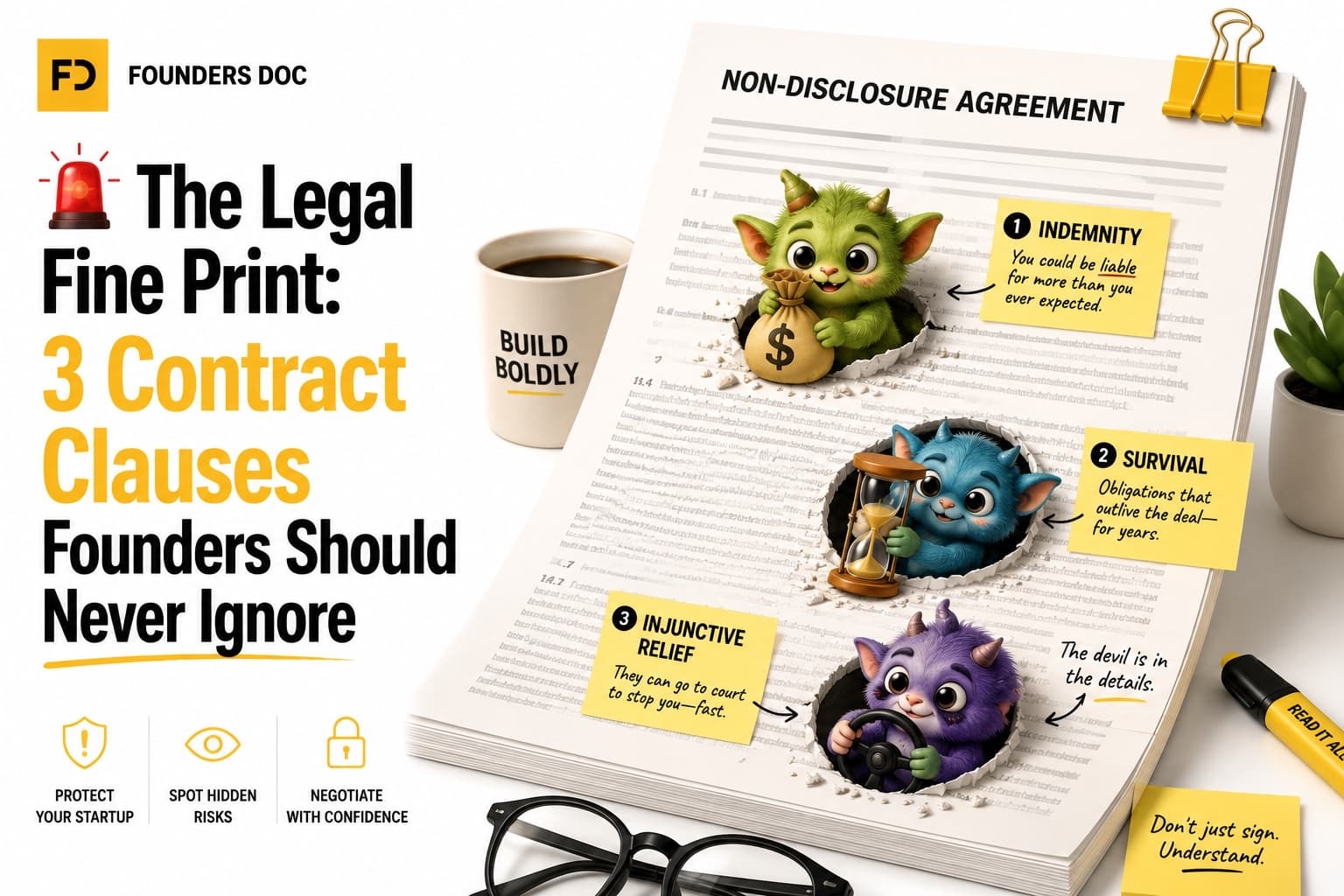
🚨 The Legal Fine Print: 3 Contract Clauses Founders Should Never Ignore
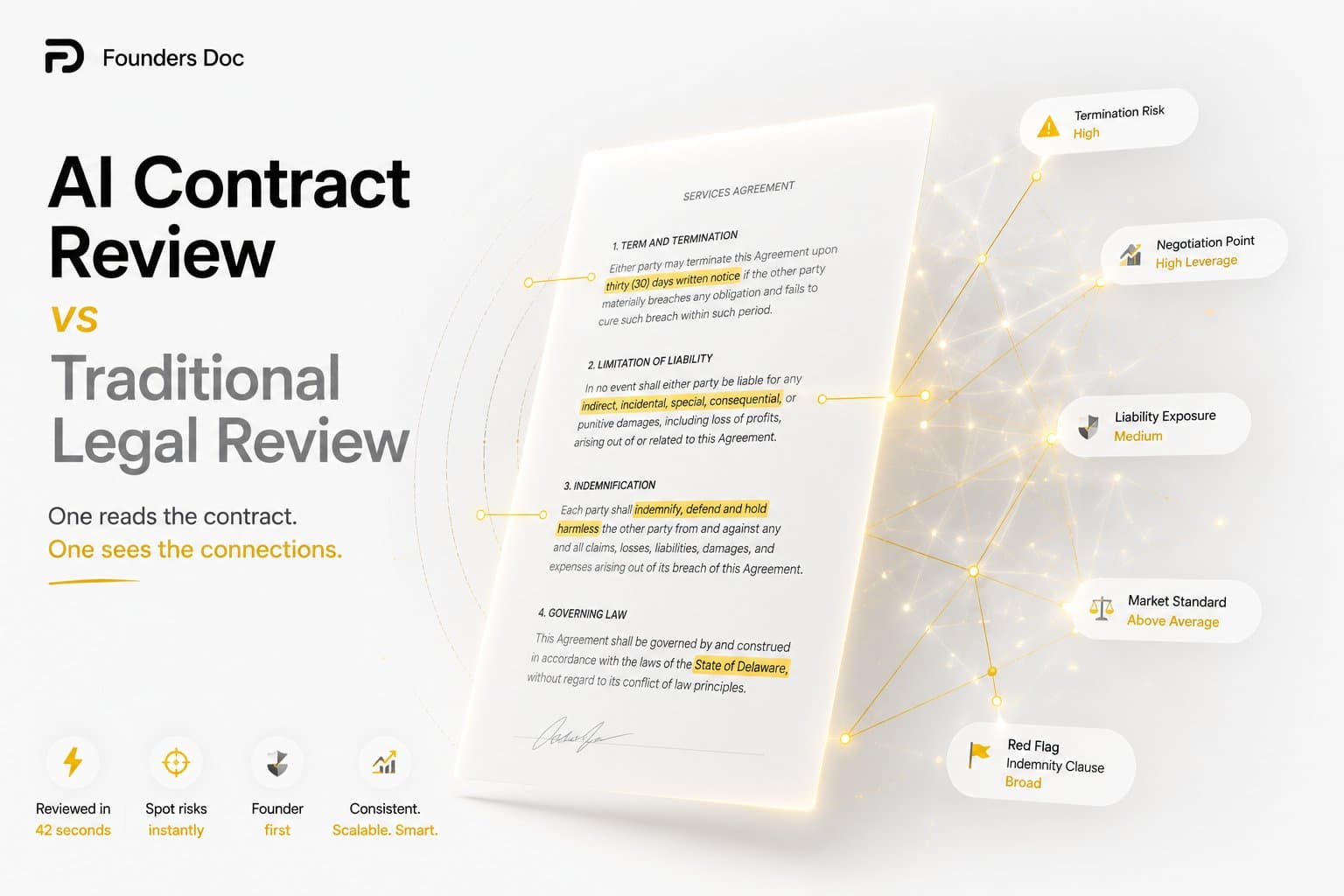
⚖️ AI Contract Review vs Traditional Legal Review: What's the Difference?
Review your next contract with Jessica.
Know what you’re signing — in minutes, not hours.